1. Who is crossing the bridge? Why are they traveling?
A. Carts, trucks, and men, women, and children were crossing it. Soldiers helped push the carts “up the steep bank.” The people were trying to get out of harm’s way. They were traveling to escape warfare.
2. Describe the old man’s clothing. What was the old man’s occupation in San Carlos? What is the narrator’s initial response to the man’s clothing?
A. The old man wore black clothes and steel rimmed glasses. The old man took care of animals. According to the narrator, “he did not look like a shepherd or a herdsman” or a person who took care of animals.
3. What explanation did the old man provide about why he left San Carlos? What concern does he have about some of the animals he left behind?
A. The old man was forced to leave his home because of impending attacks by artillery. The old man is concerned that the animals may not escape the artillery when he “was told to leave because of the artillery.”
4. Why does the old man sit there “without moving”?
A. It is because he was a weary traveler and was “too tired to go any further.”
5. What is the narrator’s business? How did the old man’s problem affect the narrator’s “business”?
A. The narrator or the young soldier’s business is to see how far the enemy has advanced. The narrator indicates that he “did this and returned over the bridge.” The fact that the old man won’t move delays his responsibility to cross the bridge as regularly as he should while conversing with the old man, he constantly looks back to determine enemy advancement. He was also listening for noises that would suggest enemy contact. He looked and listened while engaging in conversation with the old man as opposed to crossing the bridge at this point.
6. What does the old man mean when he states, “I am without politics”? Why does the old man mention his age?
A. He means that he doesn’t have political ties or affiliations. He is neutral. He mentions his age because he believes he is too old to be walking as far as he has to escape the devastating effects of war started by politics.
7. What is “all the good luck that old man would ever have”? Why might the old man need good luck?
A. The narrator has reached a state of resignation. The will he had to help the old man has given way to luck. The old man, at this point, only has luck on his side. “All of the good luck” was the fact that the sky was overcast, creating a low ceiling that prevented enemy airplanes from flying. Also, some of the animals that he cared so much about, that kept him going—the cats—could take care of themselves. He might need good luck because he has not moved and the Fascists were advancing.
8. Characterize the narrator’s attitude toward the old man. Cite evidence from the text to support your response.
A. The narrator initially has concern that the old man is not moving in light of an enemy attack. The narrator gives him a way (trucks) to an alternate destination (Barcelona). He tries to assure the old man that the doves will be fine since he unlocked the cage. He also allowed the man to rest and then urged him to move. This attitude of concern later shifts to pity as he realizes that “there was nothing to do about him.”
9. Describe the tone in the beginning of the story and at the end of the story. How does the tone shift and what causes that shift?
A. At the beginning of the story, the tone is one of patience and reassurance as the narrator engages the old man in conversation, assuring him that most of his animals will be fine, offering him alternative routes to leave dangerous territory, and even allowing him to rest a while. At the end of the story, however, the tone becomes urgent as the narrator tells the old man to “get up and try to walk now” because of the advancing enemy. It is even tinged with despair as we realize that the attempts made by the narrator are futile because the old man has not moved.
10. What does the author mean by “that ever mysterious event called contact”? Why does the author state, “and the old man still sat there”?
A. In this story “contact” means “enemy sighting or attack.” It is only a matter of time before the narrator hears the sounds that signal that the enemy has been spotted or has attacked, but even with this impending and unpredictable contact, the old man has not moved. The old man’s refusal to move suggests his sense of helplessness or the futility of moving in the face of the advancing enemy.
11. Why does the narrator note that the old man spoke “dully, but no longer to me”?
A. The narrator emphasizes here that the old man ceases to talk specifically to him, for the old man is tired and sees no use in it. He instead resorts to talking to himself, still trying to understand his current situation of being displaced by war in light of the fact that he was “only taking care of animals.”
12. What does the narrator mean by “There was nothing to do about him”?
A. The narrator meant that he could do no more to help the old man, so he gave up, and felt helpless as “the Fascists were advancing toward the Ebro.”
13. What was the old man’s occupation? How was it interrupted?
A. The old man offers information about his occupation without being asked. This is one of the first instances in which we see the old man’s preoccupation with his animals that he “had to leave.” We also see it throughout his conversations with the narrator. To some degree, this was the old man’s “business”. The war, unfortunately, has interrupted his “business” of taking care of the animals in that he was forced to leave them. He was given no choice.
14. How does the narrator try to resolve the old man’s concerns about his animals?
A. The Narrator tries to engage in a conversation and inquires if he had left the dove cage unlocked. He tries to reassure him that the animals would be fine. At regular intervals, he reminds him to cross the bridge. The narrator becomes a friend in need for the old man but he is not able to relieve him of his worries. The old man surrenders to his fate and till the end he only thinks of his animals. The narrator thus realizes that nothing can be done about him and moves on leaving him at the bridge.
15. The story is set on an Easter Sunday, which symbolically shows renewal and peace. How is it ironical with reference to the events in the story?
A. The action of the story is set on Easter Sunday, the day when Jesus Christ rose from the dead on the third day after he was crucified. Thus, Easter is symbolically viewed as a welcome time of rebirth, renewal and possible change. However, for the old man at the bridge, this day meant inevitable death and the destruction of that was meaningful to him.The image of resurrected Christ is like the image of the old man’s doves being released from their cage, both being symbols of hope and peace. The soldier , however, is not hopeful about the old man’s fate-he bitterly remarks that ‘all the good luck that old man would ever have’ was the fact that the artillery planes of the enemy could not fly that day.
16. What do the incidents in the story show about the consequences of the war?
A. The Spanish civil war forms the background to the story and Hemingway depicts that how in times of war man acts inhumanly to his own race. War causes and death and destruction, and this is highlighted through the condition of the old man who can be seen as the symbol of civilian victims of war. The old man gives meaning to his life by taking care of his animals, but the war takes away everything from him. He sits alone by the side of the road; he is as helpless as his goats; he cannot escape and is too old and tired to save himself.
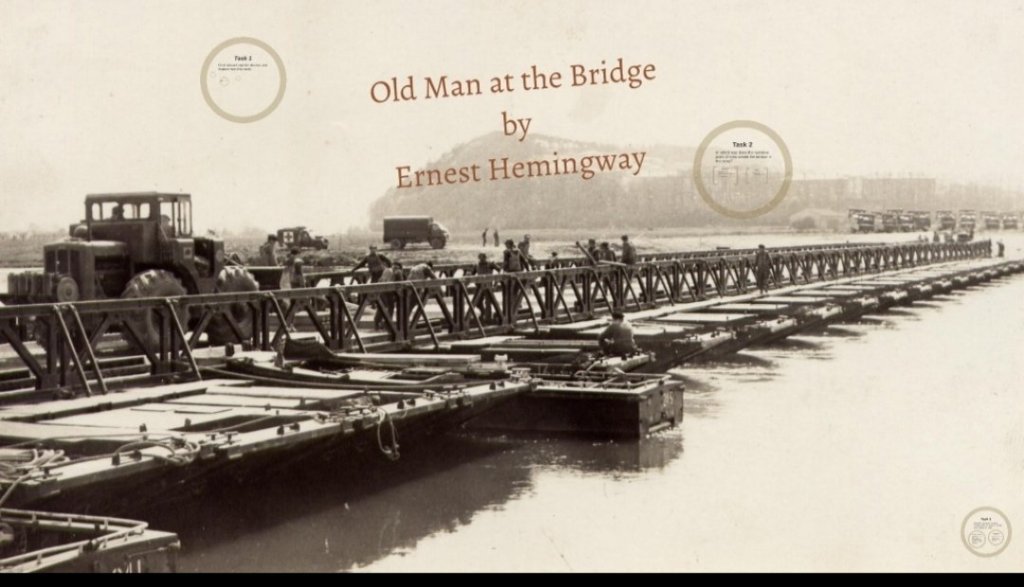
Old Man at the Bridge
Extract I
There was a pontoon bridge across the river…..he was too tired to go any further.
1. What is a pontoon bridge? Why are many people crossing the bridge?
A bridge that is made of large hollow containers filled with air is called a pontoon bridge.
The story is set during the Spanish Civil war and people are crossing the bridge to protect themselves from the impending attack by the enemy troops.
2. Where is the old man sitting? Unlike others, why doesn’t he move?
The old man was too tired to go any farther because he had already walked twelve kilometers since he left his hometown, San Carlos.
3. Who is the speaker in the above extract? Why is he there?
The unnamed narrator, who is an army scout is the speaker. He was on a mission to cross the bridge and find out how far the enemy had advanced.
4. What is the first question that the narrator asks the old man? What does he answer? Why does the old man smile?
The narrator asked the old man where he came from. The old man replied, “ San Carlos”, and he smiled because the mention of his native town gave him pleasure.
5. Why is the old man the last one to leave his town? Describe his physical appearance.
The old man was the last to leave because he was taking care of his animals. The old man wore dusty clothes and steel rimmed spectacles. His face was grey and dusty.
Extract IIHe did not look like a shepherd…. “What animals were they?”
1. Who is referred to as He in the extract above? In what condition is he?
Old man is He. He is in a weary condition as he has already walked twelve kilometers and too tired to move further. Moreover his clothes are dusty and his face has turned grey.
2. What all animals did he own? What kind of relationship did he share with them?
He had two goats, a cat and four pairs of pigeons. The animals were his family; he loved them and cared for them so much that separating from them made him feel that he had lost his reason for existence.
3. What did he do with the animals? What forced him to do so?
He left the animals behind in his native town of San Carlos. They heavy firing from the enemy forced him to do so.
4. Why doesn’t the old man cross the bridge and escape to a safer place?
He had already traveled twelvekilometers, so he was too tired to go any further. He was weak, the old man had no family and he had left his animals behind, he felt helpless as he couldn’t save his animals; he surrendered himself to his fate.
5. What do the incidents in the story show about the consequences of the war.
The Spanish civil war forms the background to the story and Hemingway depicts that how in times of war man acts inhumanly to his own race. War causes and death and destruction, and this is highlighted through the condition of the old man who can be seen as the symbol of civilian victims of war. The old man gives meaning to his life by taking care of his animals, but the war takes away everything from him. He sits alone by the side of the road; he is as helpless as his goats; he cannot escape and is too old and tired to save himself.
Extract III“I am without politics…..forks for Tortosa.
1. What does the old man mean when he states, “ I am without politics”? Why does he mention his age?
Like other innocent civilians what matters to the old man is his home and animals rather than politics. He mentions his age along with the fact that he had already walked twelvekilometers to reflect the extent of his weariness.
2. Describe the old man’s appearance. What was he doing in San Carlos?
The old man wore steel rimmed spectacles; his clothes were black and dusty and his face had turned grey from dust. In San Carlos, he was taking care of his animals.
3. The narrator says “ This is not a good place to stop.” Which place is he referring to? Why is it not advisable to halt there?
The place referred to is a war zone at a pontoon bridge across the Ebro river. The place is 12kilometers from San Carlos in Spain.
4. What does the narrator give to the old man? How does the old man react to it?
The narrator advised the old man to cross the bridge and catch a truck towards Barcelona. But the old man replied that he did not know anyone there. However, he thanked the narrator for his suggestion and continued to express his concern for the fate of the animals he had left behind.
5. Explain why the old man finally resigns to his fate.
The Spanish civil war forms the background to the story and Hemingway depicts that how in times of war man acts inhumanly to his own race. War causes and death and destruction, and this is highlighted through the condition of the old man who can be seen as the symbol of civilian victims of war. The old man gives meaning to his life by taking care of his animals, but the war takes away everything from him. He sits alone by the side of the road; he is as helpless as his goats; he cannot escape and is too old and tired to save himself. Forced to flee his town the old man sits near the Ebro river; he surrenders to his fate and waits for his impending death.
Extract IVHe looked at me very blankly….think about others?
1. Why does the old man look blank and tired? How can you say that the old man needed someone to talk to?
The man was forced to flee from his native town, leaving behind his only family i.e. his animals. He was concerned for them but did not know what to do. It made him blank. Moreover, he was 76 years old man who had alreadytraveled twelve kilometers so he was tired.
The manner in which the old man engaged in a conversation with the narrator and told him about his village and animals shows that he needed someone to talk to.
2. What is the cause of old man’s worry and guilt?
The old man believed that he must watch over the cat, the goats and the pigeons in San Carlos. The man was not able to fulfill his responsibilities so was guilty and wondered what would the animals do in his absence.
3. Explain how the story brings out the conflict between man and his inner self.
The story has two levels of conflicts. One of the conflicts is that between man and his inner self which is seen in the character of the old man. The old man is guilty of leaving his animals behind for the fear of fire by the artillery.
Man against another man is the other conflict in the story. In times of war, a man causes pain and suffering to another man. He fights with his own race for a seemingly greater good.
4. The old man seems to have given up on his life. Do you agree? Why ?
Yes, it seemed that the old man had given up on his life:
He was not concerned for his safety. He sat by the side of the road at a pontoon bridge in the war zone. Despite repeated insistence from the narrator to save his life and to catch a truck to Barcelona, the old man paid no heed. He was preoccupied only with the fate of his animals he had left behind in San Carlos.
5. How does the narrator try to relieve the old man of his worries? Does he prove successful? Support your answer with instances from the story.
The Narrator tries to engage in a conversation and inquires if he had left the dove cage unlocked. He tries to reassure him that the animals would be fine. At regular intervals, he reminds him to cross the bridge. The narrator becomes a friend in need for the old man but he is not able to relieve him of his worries. The old man surrenders to his fate and till the end he only thinks of his animals. The narrator thusrealizes that nothing can be done about him and moves on leaving him at the bridge.
Extract V“ I was taking care of animals……would ever have.
1. Why does the narrator note that the old man spoke ‘dully’
The old man had lost all hope and was filled with guilt for not being able to look after his animals. War thus does not only cause physical destruction but also psychological destruction.
2. What makes the narrator feel that “ there was nothing to do about him?”
The Narrator tries to engage in a conversation and inquires if he had left the dove cage unlocked. He tries to reassure him that the animals would be fine. At regular intervals, he reminds him to cross the bridge. The narrator becomes a friend in need for the old man but he is not able to relieve him of his worries. The old man surrenders to his fate and till the end he only thinks of his animals. The narrator thusrealizes that nothing can be done about him and moves on leaving him at the bridge.
3. State how both the narrator and the old man are depicted as helpless by the end.
The old man loved his animals so much that separating from them made him feel that he had lost his reason for existence. The old man, like his goats, had no one to take care of him and thus he surrendered to his fate.
The narrator lends a kind ear to the old man and urges the man to get up and cross the bridge; the man tries but fails. The soldier feels sorry for him. Thus the story ends with the old man’s concern for the goats and the soldier’s concern for the man.
4. What is “all the good luck that old man would ever have?”
All the luck that he would have is that the cats could protect themselves and as the day was overcast, the Fascists would not launch their planes to attack the local people.
5. The story is set on an Easter Sunday, which symbolically shows renewal and peace. How is it ironical with reference to the events in the story?
The Old Man at the Bridge, the action of the story is set on Easter Sunday, the day when Jesus Christ rose from the dead on the third day after he was crucified. Thus, Easter is symbolically viewed as a welcome time of rebirth, renewal and possible change. However, for the old man at the bridge, this day meant inevitable death and the destruction of that was meaningful to him.
The image of resurrected Christ is like the image of the old man’s doves being released from their cage, both being symbols of hope and peace. The soldier , however, is not hopeful about the old man’s fate-he bitterly remarks that ‘all the good luck that old man would ever have’ was the fact that the artillery planes of the enemy could not fly that day.
 ICSE /CBSE /ISC HUB